
Stranded in the desert with a dead battery? Before you reach for the aspirin, learn the hard science of improvised power generation. From “Earth batteries” to the voltage-boosting “Joule Thief,” here is your definitive guide to emergency electrochemical engineering.
In an off-grid emergency, power isn’t just about convenience—it’s about communication, signaling, and survival. Whether you are dealing with a terminal lead-acid failure in a remote environment or need to fabricate a cell from scavenged scrap, understanding the molecular dance of electrons can be the difference between a rescue and a tragedy.
1. Reviving the Dead: The Truth About Battery Additives
When an automotive battery fails in extreme heat, the culprit is usually sulfation—the hardening of lead sulfate crystals into an insulating layer that prevents recharging. In a survival scenario, you may have heard of two common “cures”:
The Aspirin Myth (Acetylsalicylic Acid)
Survivalist lore suggests adding aspirin to battery cells to “kickstart” the chemistry.
- The Reality: Aspirin undergoes hydrolysis in sulfuric acid, breaking down into acetic acid. While this may provide a brief, one-time ionic surge sufficient for a final engine turn, the acetic acid aggressively corrodes the lead dioxide plates, leading to a permanent internal short-circuit. Use this only if it is your absolute last chance to start the engine before abandoning the vehicle.
The Epsom Salt Solution (Magnesium Sulfate)
Unlike aspirin, Epsom salts ($MgSO_4$) can act as a temporary chemical bridge.
- The Method: Dissolve Epsom salts into a saturated solution with distilled (or bottled) water and add it to the cells. It can help break down the insulating sulfate layers enough to allow the battery to accept a charge from a solar panel or a donor vehicle. It won’t restore the battery’s original capacity, but it can buy you enough time to reach civilization.
2. The Connection: Jump-Starting Topology
If a donor vehicle is available, the connection sequence is a critical safety protocol to prevent hydrogen explosions. Lead-acid batteries vent highly flammable hydrogen during rapid charging.
- Parallel is Key: Always connect batteries in parallel (Positive to Positive, Negative to Ground). This sums the amperage (Cold Cranking Amps) needed to turn the starter motor.
- Connection Order:
- Red (Positive) to dead battery.
- Red (Positive) to donor battery.
- Black (Negative) to donor battery.
- Black (Negative) to an unpainted metal surface on the dead car’s engine block—as far from the battery as possible.
3. Fabricating Power: Improvised Galvanic Cells
When the lead-acid system is beyond repair, you must become a “maker.” Any battery requires three things: an anode (metal that loses electrons), a cathode (metal that gains them), and an electrolyte (an ionic conductor).
The Cactus Battery (Opuntia)
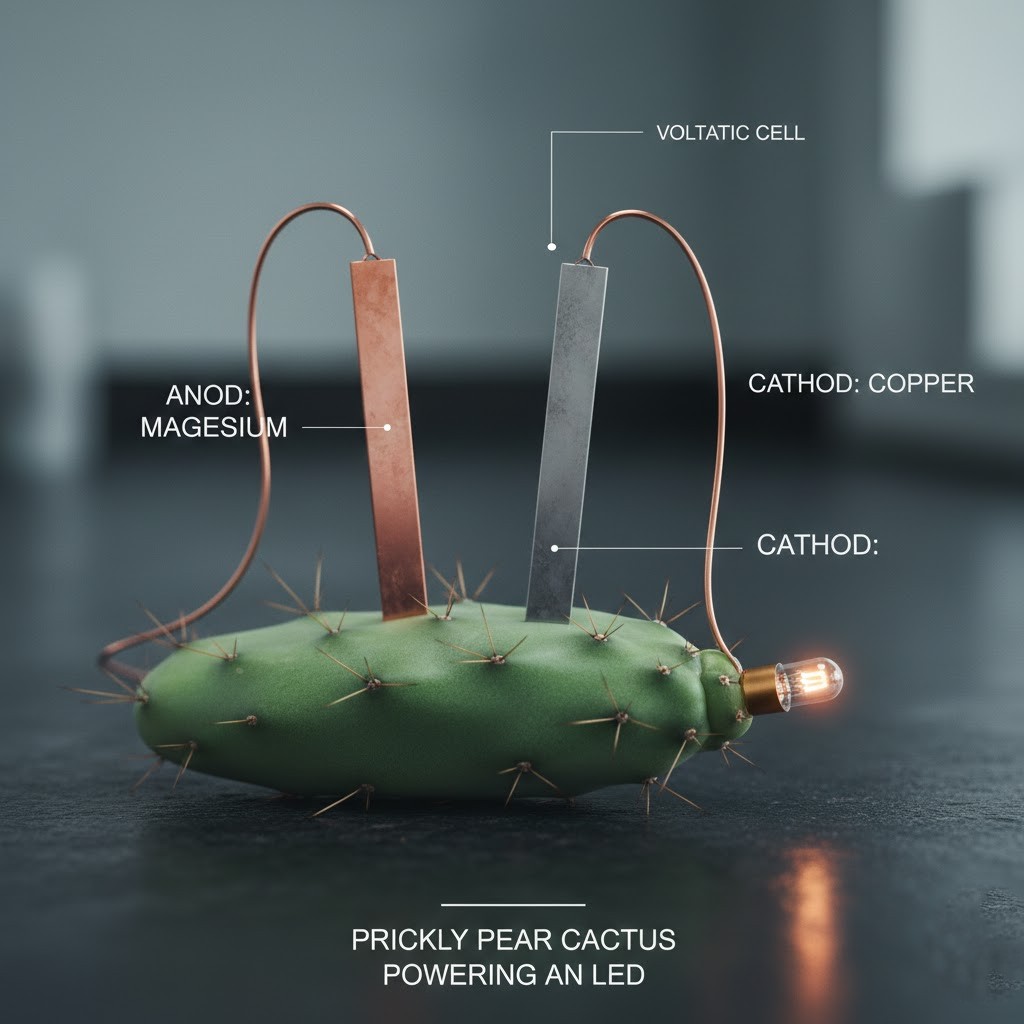
In arid regions, the Prickly Pear cactus is a pre-packaged electrochemical cell.
- The Science: Cactus pads are rich in citric and oxalic acids, which serve as excellent electrolytes.
- The Build: Insert a magnesium strip (anode) and a copper strip (cathode) directly into a cactus pad. A single cell can produce nearly 1.5 volts and remains remarkably stable for over 100 hours.
The Earth Battery
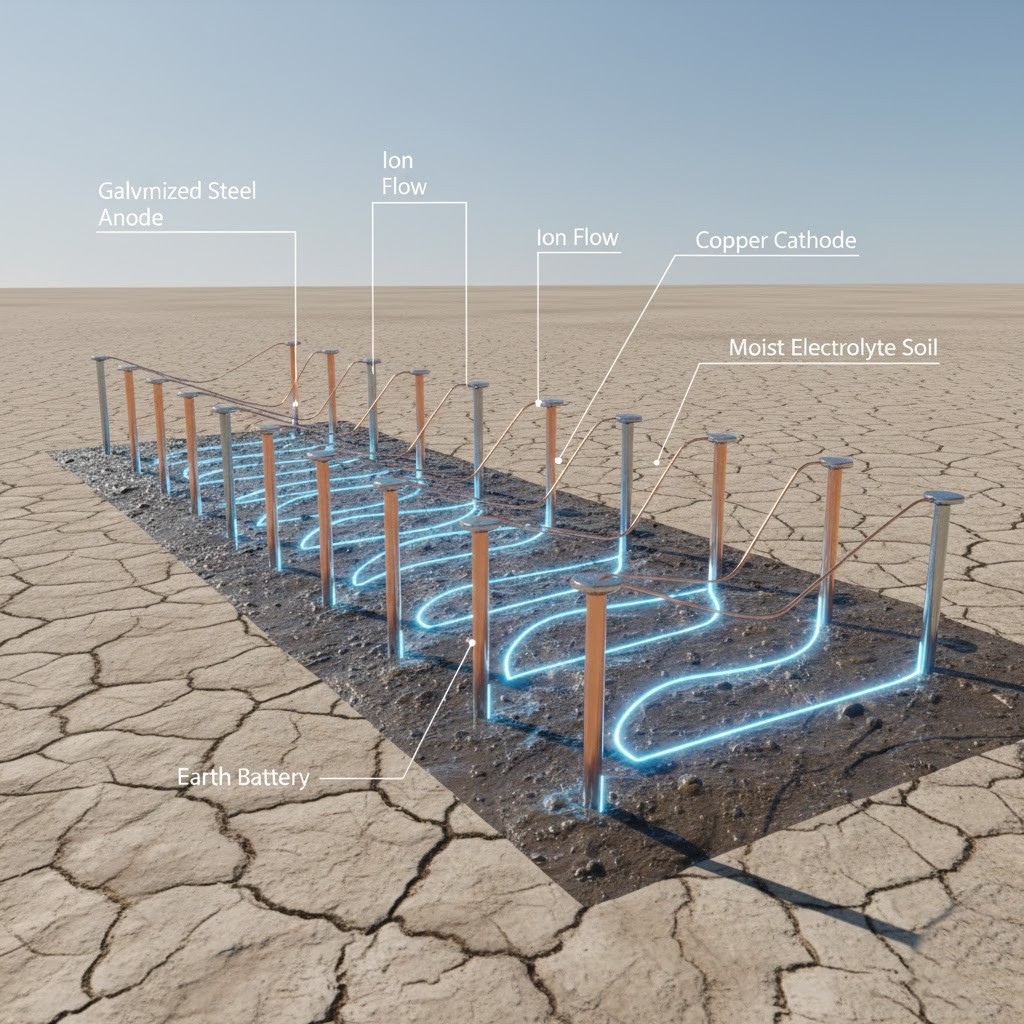
Utilized since the 1840s, the Earth itself can act as your electrolyte.
- The Build: Bury galvanized nails (zinc anode) and copper spikes (cathode) in the most moisture-rich soil available (near desert flora or in a dry riverbed). A single cell yields 0.5V to 1.0V. By connecting multiple cells in a series—planting pairs every 5-6 feet—you can generate enough voltage to power a small radio or signal light.
Urine-Activated Cells
Human waste is a high-performance electrolyte due to its ammonia and salt content.
- The Build: A simple plastic bottle filled with urine and two dissimilar metals (like aluminum foil and a carbon rod from a pencil or old battery core) can generate approximately 1.5 volts from just a few milliliters of fluid.
4. The “Joule Thief”: Squeezing Energy from “Dead” Sources
Improvised batteries often produce low voltage. To light an LED (which requires ~2V-3V) from a 0.5V Earth cell, you need a Joule Thief circuit. This “vampire” circuit uses a transistor and a coil to create high-voltage spikes through back-EMF.
- The Equation: $V = L \frac{di}{dt}$
- Even a nearly depleted AA battery or a single cactus pad can power a long-lasting emergency beacon when paired with this simple circuit.
5. Critical Safety: The Chemical Hazards
Emergency engineering is dangerous. Observe these non-negotiable rules:
- The Chlorine Trap: Never add salt water to a lead-acid battery. Electrolysis will produce Chlorine gas ($Cl_2$), a lethal respiratory irritant that can kill in enclosed spaces.
- Explosion Limits: Hydrogen is explosive at concentrations as low as 4.1% in air. Always work in a well-ventilated area and avoid creating sparks near the battery vents.
- Acid Management: If battery acid touches your skin or eyes, flush with water for at least 30 minutes without interruption.