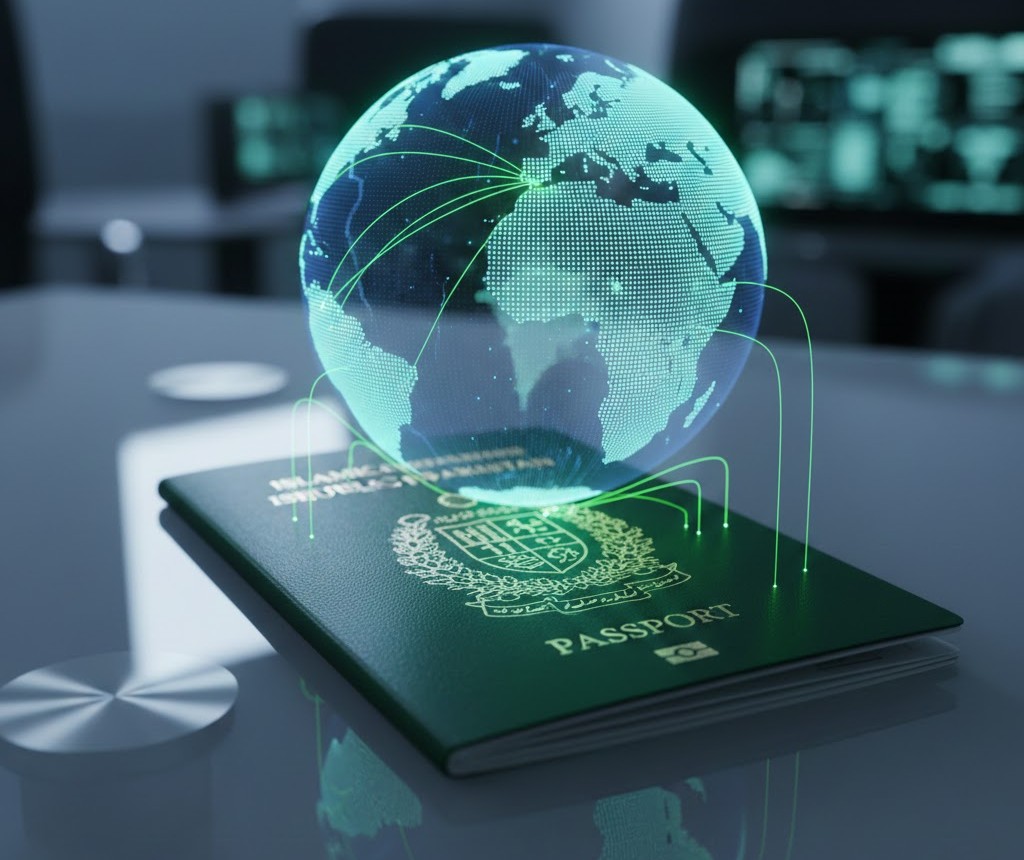
From a historic climb in global rankings to the launch of the AI-powered SHIKRA monitoring system, the Pakistani passport is undergoing its most significant transformation in decades. As of February 2026, technological integration and strategic diplomacy are finally turning the tide for the “Green Passport.”
For years, the Pakistani travel document was synonymous with limited mobility and administrative backlogs. However, the first quarter of 2026 has signaled a “geopolitical renaissance” for the nation’s travel standing. Driven by the Special Investment Facilitation Council (SIFC) and a radical overhaul of the Directorate General of Immigration & Passports (DGIP), Pakistan is transitioning from isolation to integration.
1. The Global Mobility Scorecard: February 2026 Rankings
As of February 16, 2026, the Pakistani passport has recorded an incremental but strategically vital ascent in global indices:
- Henley Passport Index: The document rose to 97th position, a jump from 103rd in late 2025 and 98th in January 2026. Pakistani citizens now enjoy visa-free or visa-on-arrival (VOA) access to 32 destinations, recently bolstered by the reinstatement of The Gambia.
- Arton Capital Passport Index: Pakistan currently holds an individual rank of 92 with a real-time Mobility Score (MS) of 46.
- Regional Context: While still in the lower tiers, Pakistan is now positioned ahead of Iraq (99th), Syria (100th), and Afghanistan (101st).
2. Administrative Mastery: The SHIKRA Monitoring System
The most transformative reform of 2026 is the inauguration of the Secure Hybrid Intelligence for Knowledge-based Response Analytics (SHIKRA) system. Launched on January 26, 2026, this digital platform provides end-to-end oversight of the entire passport lifecycle.
Key Features of SHIKRA:
- Real-Time Tracking: Every stage, from application submission to final printing and global delivery, is monitored via a 24/7 digital dashboard.
- Backlog Elimination: The system is integrated with high-speed German automatic printers capable of producing 1,000 passports per hour, effectively killing the massive backlogs of 2024–2025.
- Crowd Detection: Sensors at Regional Passport Offices (RPOs) automatically identify overcrowding to optimize staff allocation and reduce wait times.
- 24/7 Operations: To accommodate the public, selected offices in Islamabad, Karachi, and Lahore have transitioned to round-the-clock service.
3. The 2026 E-Passport: A New Standard of Security
Technological trust is being rebuilt through the nationwide rollout of ICAO-compliant biometric e-passports. These documents are considered the biggest upgrade to Pakistani identity papers since 2004.
- Security Features: The e-passport includes 29 new security elements, such as Diffractive Optically Variable Image Devices (DOVID), Multiple Laser Images (MLI), and laser-engraved polycarbonate data pages.
- E-Gate Compatibility: The embedded contactless Near-Field Communication (NFC) chip allows Pakistani travelers to use automated e-gates at major international airports, drastically reducing manual scrutiny.
- Inclusivity Reform: In a landmark move for transparency and accurate identity mapping, new passports now include the mother’s name on the data page.
4. Visa Diplomacy and the Central Asian Pivot
Under the oversight of the Special Investment Facilitation Council (SIFC), Pakistan has launched a “Revised Visa Policy” to facilitate the seamless movement of capital and people.
- Investor Facilitation: New SIFC-sponsored visa categories offer 24-hour processing for short-term investor entries from Business Visa List (BVL) countries.
- Kazakhstan Strategic Partnership: Following the 2026 state visit of President Tokayev, Pakistan has been included in the QazETA digital platform, facilitating e-visas for tourists and digital nomads visiting Kazakhstan.
- Board of Peace (BoP): Pakistan’s role as a founding member of the US-led Board of Peace has reinserted the nation into major multilateral calculations, increasing its diplomatic visibility and “legalist branding”.
5. Recalibrating Inbound Travel: The VPA Suspension
Effective January 1, 2026, Pakistan suspended its free “Visa Prior to Arrival” (VPA) program for 126 nationalities, including the US, UK, and Canada.
- The Logic: The move is intended to balance “openness” with “administrative control” and security compliance.
- New Process: Travelers from these nations must now apply for a standard paid e-visa. For example, US citizens now pay a $60 fee and face longer processing times of 7–10 business days.
- GCC Advantage: Citizens of Gulf Cooperation Council (GCC) nations retain their visa-free entry, reflecting Pakistan’s strategic economic reliance on the Middle East.
6. Strategic Challenges: The US Immigrant Visa Pause
Despite diplomatic gains, a major headwind emerged on January 21, 2026, when the US Department of State paused the issuance of all immigrant visas for nationals of 75 countries, including Pakistan.
- Public Charge Review: This “America First” pause is an administrative freeze to reassess vetting procedures regarding financial self-sufficiency.
- Scope: The pause affects green cards (IV) only; non-immigrant visas (Tourist, Student, Work) continue to be processed under heightened scrutiny.
- Diaspora Response: The Pakistani-American community, cited as one of the 10 most prosperous demographic groups in the US, is actively contesting this classification through parliamentary delegations in Washington.
Conclusion: A Nation in Transition
The 2026 reporting period confirms that the Pakistani passport is no longer a static document but a dynamic instrument of state power. Underpinned by the SHIKRA real-time monitoring system and the ICAO-standard biometric architecture, the “Green Passport” is successfully shedding its image of limitation. While significant hurdles remain—most notably the US visa pause—Pakistan’s pivot toward technological excellence and regional alliances is building the foundation for a Top 90 ranking by 2027.